Opinion
Purposeful Partnerships: The Role of Philanthropy in Shaping UK Higher Education
12 December 2025
Opinion
Purposeful Partnerships: The Role of Philanthropy in Shaping UK Higher Education
12 December 2025
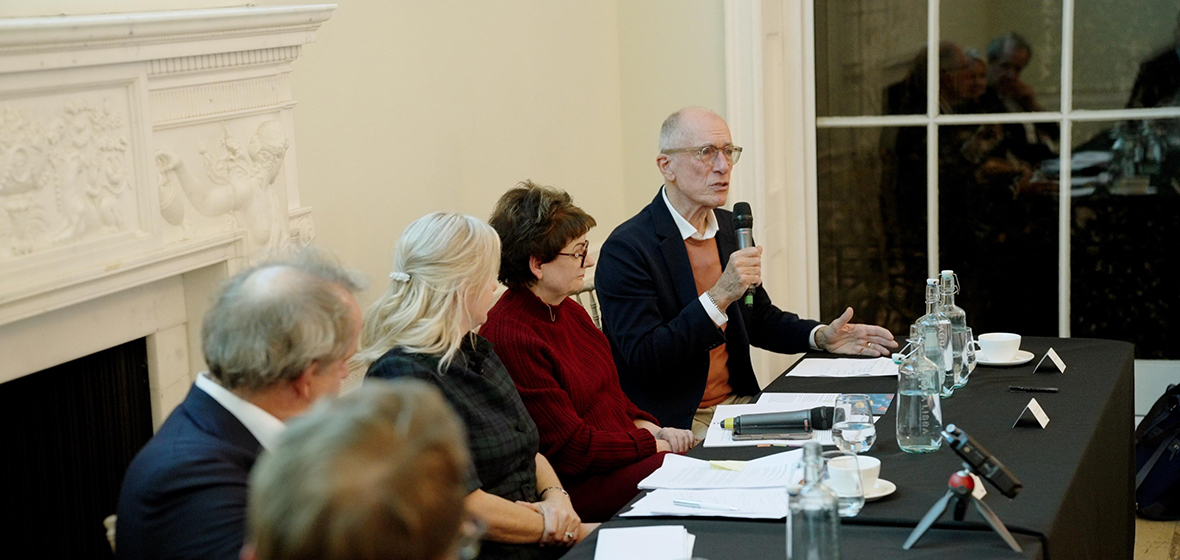
On the evening of 20 November, more than 50 senior institutional and advancement leaders gathered in London for a wide-ranging conversation on the evolving role of philanthropy in shaping the future of UK Higher Education.
Hosted by More Partnership, the event brought together an exceptional panel of philanthropists and Vice-Chancellors to explore how the sector can chart a more ambitious, inclusive and impactful course:
Rory Brooks CBE – Philanthropist, Charity Commission Board member, and trustee of IntoUniversity
Philippa Charles OBE – Director of the DFN Foundation and former Director of the Garfield Weston Foundation
Professor Duncan Ivison FAHA FRSN – President and Vice-Chancellor, University of Manchester
Professor Dame Sally Mapstone DBE FRSE – Principal and Vice-Chancellor, University of St Andrews
After a lively panel discussion, participants turned to table conversations led by More Partnership colleagues to begin crafting practical recommendations for steering that future; both within advancement teams and across the broader Higher Education landscape. These discussions are contributing to and complementing the work that CASE is leading in this area, much of which is being undertaken in collaboration with Universities UK.
While at its heart good fundraising requires a good story to tell, it also requires some people with whom to talk about the story. To have the greatest impact on the project, these prospects must not only be wealthy, but also warm enough to the institution, and its leadership.
Clear skies of purpose amid a storm of challenges
Asia House provided a wonderful setting for a discussion about how collaboration can help weather the challenges facing Higher Education. As More Associate Partner Joanna Motion wrote in her recent article, Weathering the Storm, universities are navigating a “perfect storm” of pressures. However, around the room the beacons for navigating it were clearly visible.
We heard a shared conviction about the power of philanthropy, encouragement to set ambitions higher, and optimism about the sector’s capacity to deliver meaningful change. This sentiment was also reflected in a new synthesis of hundreds of donor interviews undertaken by More Partnership, which was shared at the event.
A rising tide in UK university philanthropy
Nik Miller, Partner at More Partnership and co-author of the CASE–More UK Philanthropy Report, Accelerating Ambitions, opened the evening by reflecting on the remarkable momentum: “Philanthropy in higher education has come of age”. Philanthropic commitments to UK universities have doubled over a decade, reaching £1.5bn. The most recent CASE Insights data show that trend continuing upwards. Records are being broken and new ground is being claimed. Among the highest performing institutions in fundraising, new funds committed philanthropically account for an increasingly significant proportion of overall turnover.
The tide is rising even as external headwinds strengthen. Resources are stretched. Expectations climb. And the imperative to clearly articulate the role and value of universities grows sharper.
Setting a clear course
Even so, institutions continue to make waves. St Andrews’ Making Waves campaign is doing just that, supported by the power of a “crisply articulated ask”. Further energy was brought to the discussion with reflections on Manchester’s newly launched Challenge Accepted campaign and the many benefits of strategy and philanthropy being “strategically joined at the hip”. The careful coordination of campaign and strategy is something many leaders can influence, but too often overlook amid competing agendas.
Donors and funders, too, are looking for strategic alignment - with clarity and vision sitting at the heart of some of the most purposeful partnerships. “Donors want to back a clear strategic priority”: one supported by university leadership, underpinned financially by the institution, and animated not by rhetoric but by authenticity. Yet finding strategic clarity continues to be a challenge in many institutions whether due to lack of leadership alignment, breadth and complexity of the academic offer or simply lack of coordinated decision-making to define and articulate direction or priorities.
Leadership at the helm
One of the strongest threads of the evening was the crucial role of Vice-Chancellors in shaping philanthropic success. Leadership transitions were front of mind for many in the room.
The panel reiterated a key recommendation from Accelerating Ambitions: Advancement leaders must be part of the “essential triumvirate” of strategic leadership, alongside Vice-Chancellors and senior academics. Unsurprisingly, institutions where the Chief Advancement Officer sits on the executive team are among those thriving.
But leadership is not the preserve of senior executives. The “hope and joy” that can come from meeting the right academic or student is often catalytic for a donor. Not every academic will be a natural communicator, nor do they need to be. The advice was clear: don’t try to bring everyone on board. Instead, nurture and empower those who are eager (and able) to help make the case and inspire donors with their passion and vision.
Engines of change, and keepers of joy
Optimism in the room was fuelled by reflections on the profound impact philanthropy has across the sector, from widening access to enabling discovery to enriching the cultural and civic life of communities. The path is rarely smooth; it takes resilience and time – but joy, as our panellists reminded us, is “a massively important part” of the process.
We heard about partnership work with the University of Cambridge to build a new programme in which both partners feel wholly invested and committed to shared success through whatever challenges may arise. This was echoed in a story of a philanthropist who ensured a capital project was brought to life with art, just as historic buildings in our cities have been across the centuries.
Fundraisers, we heard from the panel, are the “deliverers of joy” – the people who bridge the gap between a philanthropist’s ambitions and the institution’s ability to realise them. As one panellist dynamically described it, “institutions are the engines, and philanthropists are the fuel. The engine cannot run without the fuel”.
True philanthropic partnerships take time to build, but once formed they become part of a donor’s identity. Institutions, and advancement professionals in particular, should take pride, more than they often do, in making extraordinary things possible. Perhaps, as the panel suggested, strong doses of humility within advancement may not ultimately serve the greater good.
Recommendations from the room
Following the panel, participants were invited to share reflections and shape recommendations for how purposeful partnerships can be strengthened in the years ahead.
Many insights emerged, but five themes stood out:
| 1. | Clarify your vision and story Even when strategic cycles are not perfectly aligned, distinctiveness matters. For some universities this may lie in clear areas of strength or priority; for more comprehensive institutions, it may be in how they make change happen, through excellence, free-thinking, and/or a strong sense of place. Be clear how you meet needs in the wider world, not simply the long list of internal budget lines. A compelling narrative, strategic focus and an emphasis on impact are essential for cutting through but how they’re framed may need to evolve as donor motivations shift across generations. Younger philanthropists seeking tangible impact now are increasingly becoming involved in the distribution of family wealth and a key group to keep front of mind. |
| 2. | Think beyond your back door Alumni bring deep loyalty and connection, but as the panel reminded us, the evidence shows that not all will give. In a sector under pressure, understanding “who engages and who doesn’t” helps focus effort where it matters. Global institutions with the strongest alumni engagement often introduce students to the value of philanthropy on the day they arrive – not the day they leave. But the room also recognised the enormous potential of non-alumni supporters. At some institutions, more than half of transformational gifts come from non-alumni. For this audience, clarity of story, differentiation, and engagement of leadership are even more critical. |
| 3. | Go further together Throughout the evening, participants questioned whether the sector is truly in competition for donations. Non-alumni donors, often among some of the most transformational in their giving, have clearly looked around for the best fit regardless of historic loyalties. Institutions with the clearest story and strongest alignment with a donor’s values will inevitably make it higher up a donor’s shortlist. But collaboration also holds power. In More Partnership’s privileged position of having spoken with more than 4,200 major donors on behalf of clients, we know that cross-institution partnerships, as well as co-creation with donors can be a compelling draw for many philanthropists. There are caveats, of course: collaboration must accelerate and enhance impact, not slow it through governance challenges or institutional politics. We heard about The Child of the North: a great example of universities aligned to deliver more than the sum of their parts to improve educational outcomes for those with the most to gain. |
| 4. | Recognising the importance of philanthropy Raising performance without institutional backing remains a challenge. Philanthropy must be embedded at the top and philanthropic culture set from the top down. Chairs of Council should ensure it is part of the Vice-Chancellor’s remit, and senior academics should understand and value the profession of fundraising. Universities should also examine structures that hinder partnership-building, including expectations and understanding of philanthropy within the university’s financial leadership, and consider placing philanthropic income on an equivalent footing with research grants –rewarded, recognised and elevated. |
| 5. | Raise our collective voice (inside and outside the sector) As a sector raising £1.5bn annually, universities should feel confident, not self-critical, in articulating the value of philanthropy and the impact they make through it. The evidence is there. We should also raise the philanthropic voice itself. We heard from the panel of ambitions to create a formalised representative body for philanthropists, recognising the challenge of reflecting what is a “beautifully fragmented, independent, inspiring and deeply individual group of people”. This has partly emerged in response to historic interactions between individual philanthropists and government that have often produced unclear outcomes. There are many actions that are only possible with a collective voice; outcomes that no individual institution can drive alone. Participants encouraged future efforts to focus less on individual profiles and more on the impact made possible through philanthropy. Encouraging philanthropists to speak openly about the meaning and joy of giving, in a way that Peter McMullin and John and Marcy McCall MacBain have, will strengthen public understanding of why philanthropy matters. And we support policymakers shaping the future of Higher Education in welcoming those voices to the table. It is encouraging to see CASE focusing on this future, working with organisations including Universities UK, the Committee of University Chairs (CUC) and the Chartered Institute of Fundraising to help shape the conditions for stronger philanthropic culture across the sector. Their focus on building leadership capability, nurturing professional talent, strengthening sector reputation and developing a shared advocacy agenda reflects the collaborative ambition that will be essential. |
In conclusion
The conversation continues and we plan to reconvene at a similar event in 2026. For now, we leave you with sincere thanks to the panel and all who attended, and this closing refrain:
Be purposeful.
Be bold.
And keep bringing the joy.
A PDF version of this article can be downloaded from our Library here: Purposeful Partnerships.pdf